
Xinhua(2026-05-19): Feature: Chinese Juncao technology transforms dairy farming in Tanzania's Zanzibar
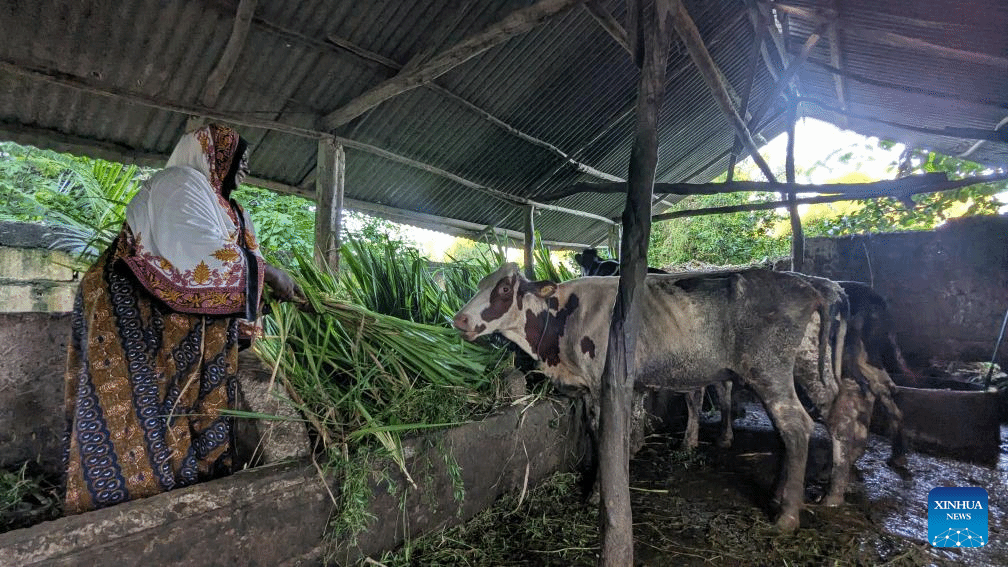
Tahiya Bauso Massawe, a Tanzanian dairy farmer, feeds cows with freshly cut Juncao grass at a dairy farm in Zanzibar, Tanzania, May 12, 2026. (Xinhua/Nurdin Pallangyo)
by Xinhua writers Hua Hongli, Lin Guangyao, Lucas Liganga
DAR ES SALAAM, May 18 (Xinhua) -- In the quiet farming village of Bumbisudi on Tanzania's semi-autonomous island of Zanzibar, dairy farmer Tahiya Bauso Massawe walks through rows of towering green grass, brushing her hands against leaves that sway gently in the coastal breeze.
What once looked like an ordinary pasture has become the backbone of a transformation -- not only for her dairy business, but also for many smallholder farmers searching for a way out of low productivity and uncertain incomes.
The grass is called Juncao, a technology developed in China and introduced to Tanzania through agricultural cooperation programs. For Massawe, it has brought more milk, more jobs, and renewed confidence in the future of rural farming.
"Through this Juncao project, we planted it in large quantities and fed it to our cows. We saw a clear difference compared to ordinary grasses," Massawe said while tending to her dairy herd.
For years, livestock keepers across Zanzibar depended on traditional fodder such as ukoka and pembergrass. During dry seasons, grass often withers, leaving farmers struggling to feed their animals and maintain milk production, which makes dairy farming unpredictable and financially draining.
That began to change after Zanzibar's Ministry of Agriculture, Natural Resources, Irrigation, and Livestock introduced Juncao technology to local farmers and trained them on how to cultivate and use the grass as livestock feed.
"We were guided on how to feed this nutritious grass that can increase milk production," she said.
Massawe recalled a difficult period when she ran out of bran and commercial feed supplements, causing milk production to drop sharply. Yet after feeding the cows Juncao for only a few days, production rebounded.
"When I continued feeding Juncao for two or three days, I saw the cows restore milk production to the same level I used to get when I gave them bran and supplements," she explained.
Today, her farm produces between 100 and 120 liters of milk every day, nearly double the amount she once achieved using conventional feeding systems.
To sustain the output, she has devoted more than seven acres of land to cultivating Juncao.
"My system is continuous. When I finish cutting one field, I move to another. By the time I return, the first one has grown again," she said.
The gains have extended beyond milk yields. The farm now employs more than 16 workers, including women and young people involved in fodder cultivation, milking, and farm management.
The success has also strengthened farmers' credibility with financial institutions.
"Through Juncao grass, we are trusted by agricultural banks," she said. "When they saw that we adopted this improved feed, they even provided loans for cows. This helped us expand."
Juncao technology was invented by Chinese scientist Lin Zhanxi of Fujian Agriculture and Forestry University in the 1980s. The comprehensive system uses specially developed grasses for mushroom cultivation, livestock feed, ecological restoration, and organic fertilizer production.
The technology first entered Tanzania through pilot mushroom-growing projects. Wider adoption began after Tanzanian ecologist Elly Ligate returned home in 2018 after completing doctoral studies at China's Fujian Agriculture and Forestry University.
In 2019, Ligate helped establish a Juncao nursery at Sokoine University of Agriculture (SUA) in Morogoro, paving the way for the technology to spread across mainland Tanzania and Zanzibar.
"Since then, experts from the China National Engineering Research Center of Juncao Technology have continued supporting implementation in Tanzania," Ligate, a lecturer at SUA, told Xinhua.
According to Ligate, now more than 2,000 Tanzanians cultivate Juncao grass for livestock feed, while about 500 farmers use it as a substrate for mushroom cultivation.
He described the technology as a practical solution to some of the country's pressing rural challenges, including feed shortages, declining soil fertility, and low agricultural productivity.
"Juncao technology supports income generation, ecological restoration, and sustainable livestock feeding," Ligate said.
The Tanzanian government has intensified efforts to promote innovation.
On the mainland, the Ministry of Livestock and Fisheries supports the multiplication and distribution of Juncao cuttings, while Zanzibar's Ministry of Agriculture, Natural Resources, Irrigation, and Livestock coordinates implementation on the islands. Government-owned farms are also being used to multiply planting materials for distribution to farmers nationwide.
For Massawe, she now plans to expand irrigation systems to maintain year-round fodder production and ensure stable water supplies for livestock during dry periods.
Standing beside the lush fields that have reshaped her future, Massawe said she also hopes more women in her community can benefit from the same opportunity.
"My goal is to improve irrigation, so I can maintain production throughout the year and help more women join this system," she added.
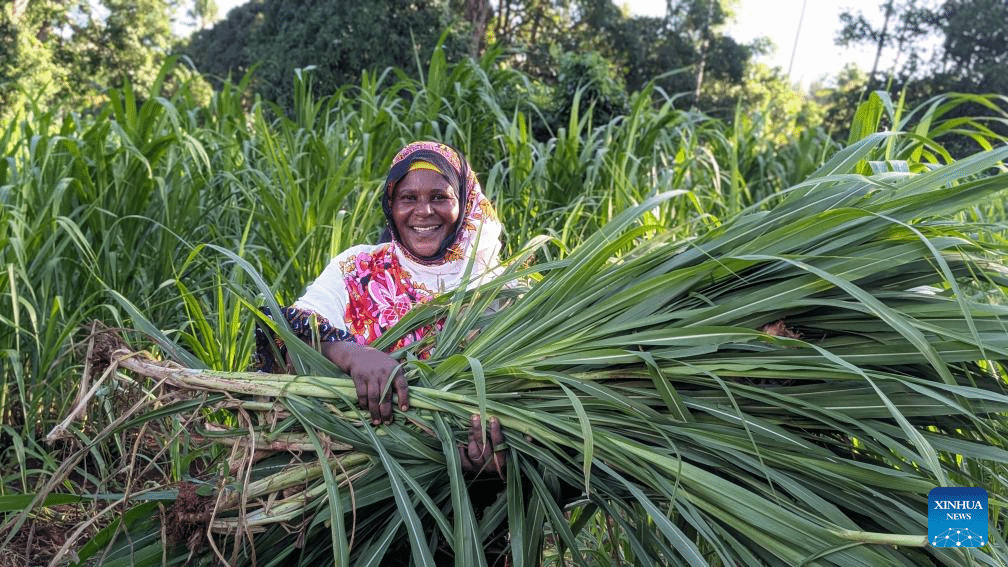
Tahiya Bauso Massawe, a Tanzanian dairy farmer, carries freshly harvested Juncao grass in Zanzibar, Tanzania, May 12, 2026. (Xinhua/Nurdin Pallangyo)
来源:https://english.news.cn/africa/20260519/7faecc8e799e42b7a81e2d4fd3b7bba6/c.html
【关闭】